Introduction
John Keats 1795-1821 remains one of the most beloved figures of English Romantic poetry. Although his life was tragically short. His work display extraordinary richness, sensuous imagery and an unshakable devotion to beauty.
He was not only a poet of imagination but also a thinker. Who struggled with the meaning of life, love and death. Today Keats is remembered as a “ Poet Of Beauty ’’ whose lines continue to inspire generations.
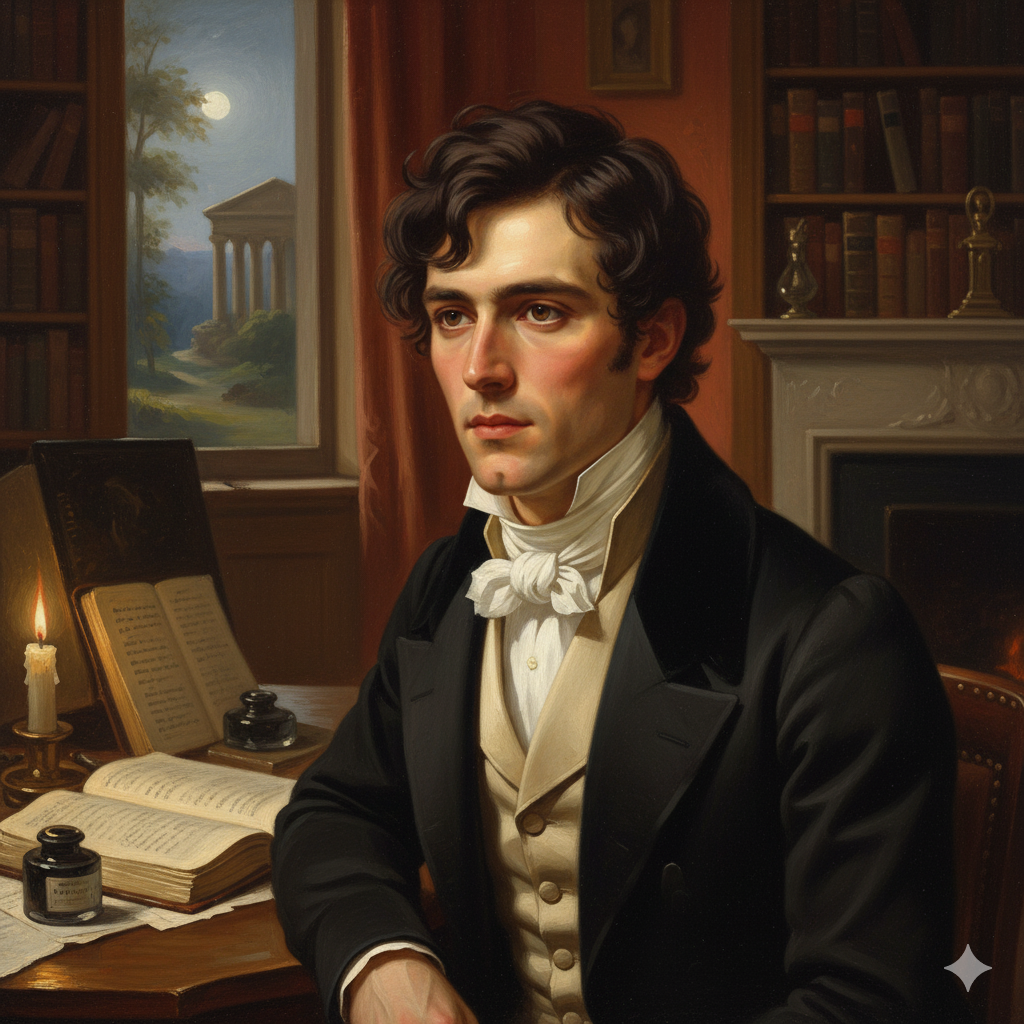
Early Life and Education of John Keats:
John Keats was born on 31 October 1795 in London, the eldest of four children. His father Thomas Keats was a stable keeper, and his mother famous Jennings died of Tuberculosis. When Keats was only 14.
These early experiences with death shaped his sensitive outlook and later influenced the melancholy tone of his poetry. Keats attended the Clarke School in Enfield where he developed a love for literature especially classical mythology and renaissance poetry.
Though initially trained in medicine and apprenticed as a surgeon. Keats soon realized that his true calling was poetry. By 1816, he abandoned his medical career and fully devoted himself to writing.
Struggles and Challenges
Keats career was not smooth. He was heavily criticized by conservative magazines like the Quarterly review and blackwood’s magazine. Which mocked his Cockney school of poetry.
These attacks deeply hurt him, but he continued to write with determination financial hardships, poor health and tragic love for Fanny Browne further shaped his emotional and artistic life.
Poetic style and characteristic
Worship of beauty:
Keats famously declared. A Thing of Beauty is a joy forever for him. Beauty wasn’t temporary but eternal existing in art, nature and imagination.
Sensuousness:
His poems are alive with rich imagery appealing to all five senses. Reading Keats feel like tasting, hearing and touching beauty.
Imagination and Escapism:
He used imagination as a refuge from the harshness of life. In poems like Ode to Nightingale. He seeks escape from human suffering into the eternal song of the bird.
Classical influence:
Greek mythology inspired much of his work. Poems like Hyperion and Endymion reflects his love for ancient legends.
Melancholy and Transience:
His works often show the life and the permanence of art.
Major works of John Keats:
• Poems(1817): His first published volume, though not widely recognized.
• Endymion (1818): A long narrative poem beginning with the immortal live, “ A Thing of beauty is a joy forever.
Ode to 1819 (Masterpieces):
Ode to Nightingale – Meditates on mortality and the eternal song of the bird.
Ode to Grecian Urn – Explore the permanence of art with the famous line: “Beauty is truth, truth beauty.”
Ode to Autumn – A lyrical celebration of nature and harvest.
Ode on Melancholy and Ode on Indolence.
Other Poems:
• Isabella, or the Pot of Basil
• The Eve of St. Agnes
• Lamia
• Hyperion ( unfinished epic)
Personal life and Love of John Keats:
Keats fell deeply in love with Fanny Browne in 1818. Their romance was passionate yet filled with sorrow, as Keats’ illness prevented marriage. His love letters to her remain among the most beautiful in English literature, revealing his sensitivity and longing.
Illness and Death:
In 1820, Keats showed symptom of the tuberculosis, the same disease that had taken his mother and brother. Doctors advised him to move to a warmer climate, and he traveled to Rome with his friend Joseph Severn.
Sadly, his health worsened and on 23rd February 1821, and only 25 years of age, John Keats passed away. His gravestone in Rome Bears the haunting words:
Here lies one whose name was writ in water.
Contribution to Literature:
Keats contributed a unique voices to the Romantic Movement. Unlike Wordsworth’s simplicity or Byron’s adventure, Keats concentrated on aesthetic beauty, artistic perfection, and imaginative vision. His odes are considered some of the finest lyrical poetry in English literature.
Pingback: Thomas Hardy – The Novelist and Poet of Human Suffering -
Pingback: On His Blindness by John Milton Easy Summary englitcorner.com