Introduction:
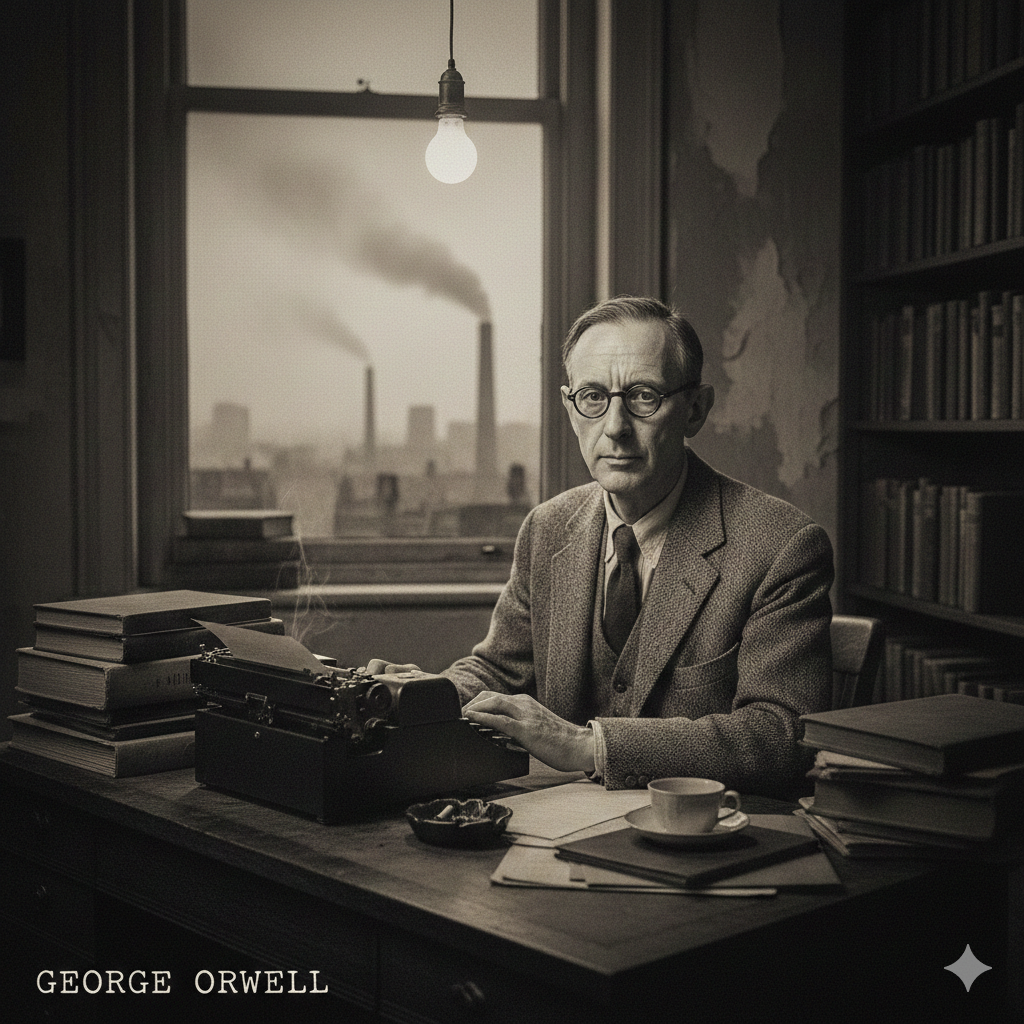
George Orwell born as ‘Eric Arthur Blair on June 25, 1903, in Motahari. India was one of the most influential English writers of the 20th Century. He wasn’t only a novelist and essayist but also a social critic who stood against injustice and falsehood. His pen was his weapon , and his truth was his power.
Early Life and Education of George Orwell:
Orwell spent his early childhood in India before moving to England for his education. He attended Eton College, one of the most prestigious schools, but financial struggles kept him grounded. His early experiences with class inequality and colonial power deeply shaped his worldview.
After, completing his studies, Orwell joined the Indian Impaired police in Bruma (Now Myanmar). The cruelty and Hypocrisy of British Colonial rule illusioned him, and he resigned to persue writing – determined to expose social evils and political corruption.
Major Works and Themes of George Orwell:
Orwell works are best known for their political insight, honesty and social awareness. His most famous novels are:
• “Animal Farm”(1945): – A political satire about power and corruption. Though the story of Farm Animal overthrowing their human owner. Orwell exposed the hypocrisy of totalitaria regimes, especially Stalin’s Soviet Union.
Famous Quote: “ All animals are equal, but some animals are more equal than others.”
• “1984” (1949): A dystopian novel that predicts a world under total surveillance and control. It introduced concepts like: “Big Brother” , Thought Police and Newspeak. This book remains one of the most powerful warning against dictatorship and loss of freedom.
Other notable works include “Down and Out in Paris and London” (1933) ”Homage to Catalonia” (1938) and “The Road Wigan Pier” (1937) – each reflecting Orwell’s compassion for the working class and his hatred of oppression.
Writing style and Ideas:
Orwell’s writing marked by simplicity clarity and moral purpose. He avoided unnecessary complexity and focused on truth. His essays such as politics and the English Language and “ Why I wrote” are masterpieces in literary honesty.
He believed that political language should never hide truth but reveal it – A principles that makes his writing eternally relevant.
Personal Life and Legacy:
Despite suffering from tuberculosis, Orwell continued to write until his death in 1950. He lived a simple life and never compromised his principles.
His commitment to truth and freedom continues to inspire writers, Journalists and thinkers around the world. Today the term “Orwellian” is used to describe situations where truth is distorted by Propaganda – A testament to how deeply his Ideas still influence modern society.
Conclusion:
George Orwell remains a symbol of courage, truth and intellectual honesty. Through his words, he taught the world to question authority and defend freedom of thought . his legacy reminds us that “In a time of deceit telling the truth is a revolutionary act.”
Discover the life, works, and legacy of George Orwell — the revolutionary English writer who exposed truth through words like never before.
English Authors, Biography, Modern Literature, Political Writers, George Orwell, Classic Literature
Pingback: The Homeric or Heroic Period in Greek Literature( 1200 – 800 BCE) - englitcorner.com
Pingback: Types of Poems in English Literature:& How Poetry Works