Introduction:
Edmund Spenser (1552-1599) was one of the greatest poets of English Renaissance. Readers remember him as the author of “The Faerie Queenie”, one of the most important poems in English Literature. He writings reflects the culture , religion and politics of Elizabethan age.
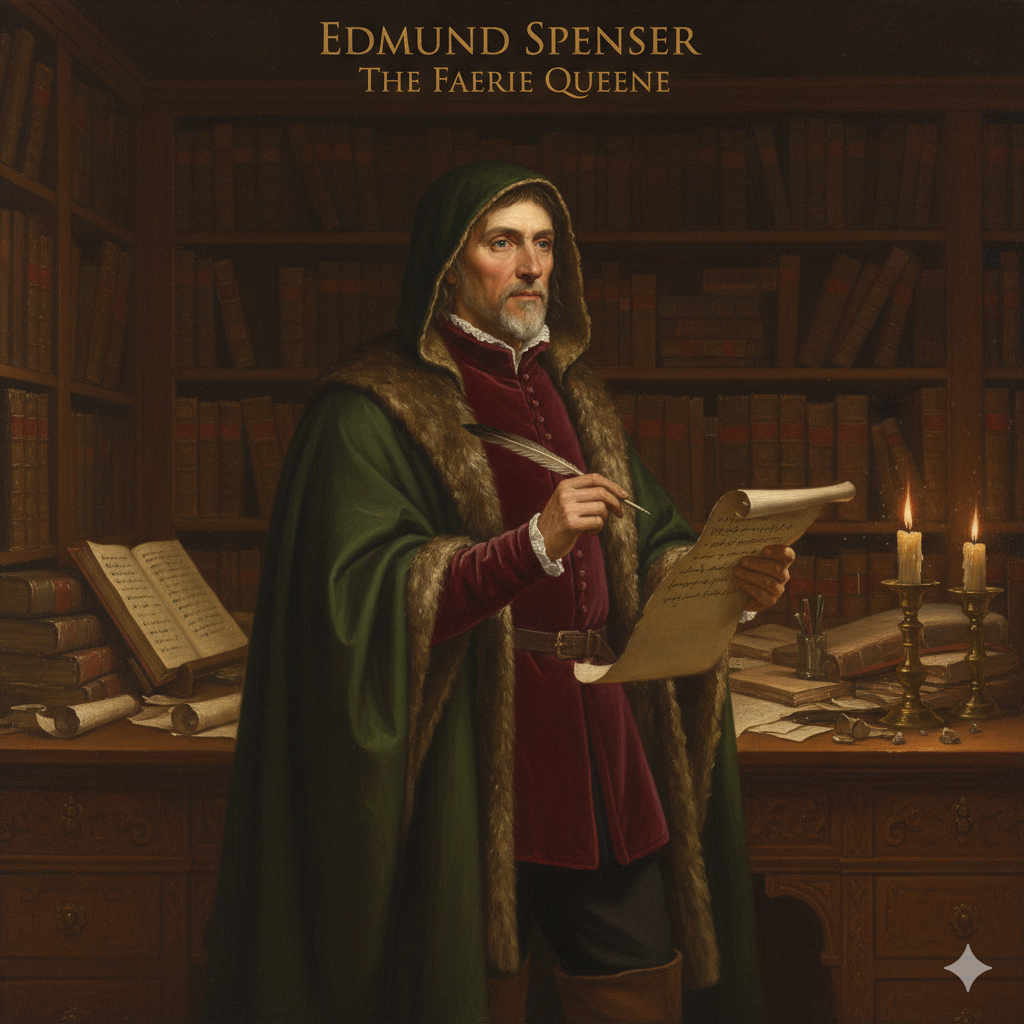
Edmund Spenser: Inspiring life and Education:
Edmund Spenser was born in London around 1552. People know very little about his family, but he came from a modest background. He studied at the Merchant Taylors School and later at the Pembroke Hall Cambridge.
During his university days, Spenser read widely in classical literature, philosophy and languages. This education shaped his poetic imagination and gave him a strong foundation in the art of writing.
Literary career of Edmund Spenser:
Spenser’s first Timeless major work was The Shepheard’s Calendar (1579). The book contains twelve pastoral poems, each representing a month of the year. This book made him famous and established him as a leading poet of Elizabethan England.
His most celebrated work , however, was “The Faerie Queenie “(1590-1596). It was written to honor Queen Elizabeth I and is and allegorical poem filled with knights, quests and moral lessons. The poem combines classical mythology with Christian virtues and English nationalism. Although Spenser planned twelve books, he completed only six before his death.
Other works by Spenser include Amoretti (a sonnet sequence), “Epithalamion” (a wedding song dedicated to his wife), and Prothalamion ( a poem celebrating marriage). His writing style is known for its musical quality and the special stanza he invented, called the “Spenserian stanza.”
Unfolding life in Ireland:
Spenser worked as a government official in Ireland, where he received and as part of English settlement policy. He lived at Kilolumen Castle, where he wrote much of The Faerie Queenie. However, he also faced conflict during the Irish rebellions. In 1598, rebels attacked his castle, forcing him and his family to flee.
Personal Life of Edmund Spenser:
In 1594, Spenser married Elizabeth Boyle, and their marriage inspired some of his most beautiful poetry, including Amoretti and Epithalamion. These poems reveal not only his literary talent but also his deep emotions as a lover and husband.
Spenser’s influence on later poets such as John Milton, John Keats, and Alfred Tennyson is immense. His combination of imagination, morality, and beauty made him one of the finest voices of English poetry.
Conclusion
Edmund Spenser was not only a poet but also a visionary who tried to connect literature with national pride and spiritual values. His works, especially The Faerie Queenie, continue to inspire readers and scholars around the world. He remains a symbol of Elizabethan creativity and poetic excellence.
Pingback: Sir Philip Sidney: A true Renaissance Poet and Courtier
Pingback: The use of nature in Romantic Poetry: Emotion, Spirit & Imagination
Pingback: Lord Byron: The Passionate voice of the romantic era -
Pingback: “William Shakespeare: The Genius Who Reshaped World Literature Forever”
Pingback: William Shakespeare: The Mind That Shaped World Literature Forever
Pingback: The Evolution of Storytelling: From Oral Tradition to Digital Narratives
Pingback: On His Blindness by John Milton Easy Summary englitcorner.com
Pingback: An Essay on Criticism by Alexander Pope - Timeless Rules of criticism englitcorner.com