Introduction
John Milton (1608-1674) is one of the greatest poets in English Literature. He is best remembered for his epic poem Paradise Lost, which explore the fall of man and the eternal struggle between good and evil.
But Milton was not only a poet; he was also a thinker, a political writer, and a man who believed strongly in freedom , justice , and the power of words. His life was filled with struggles, achievements, a passion for truth.
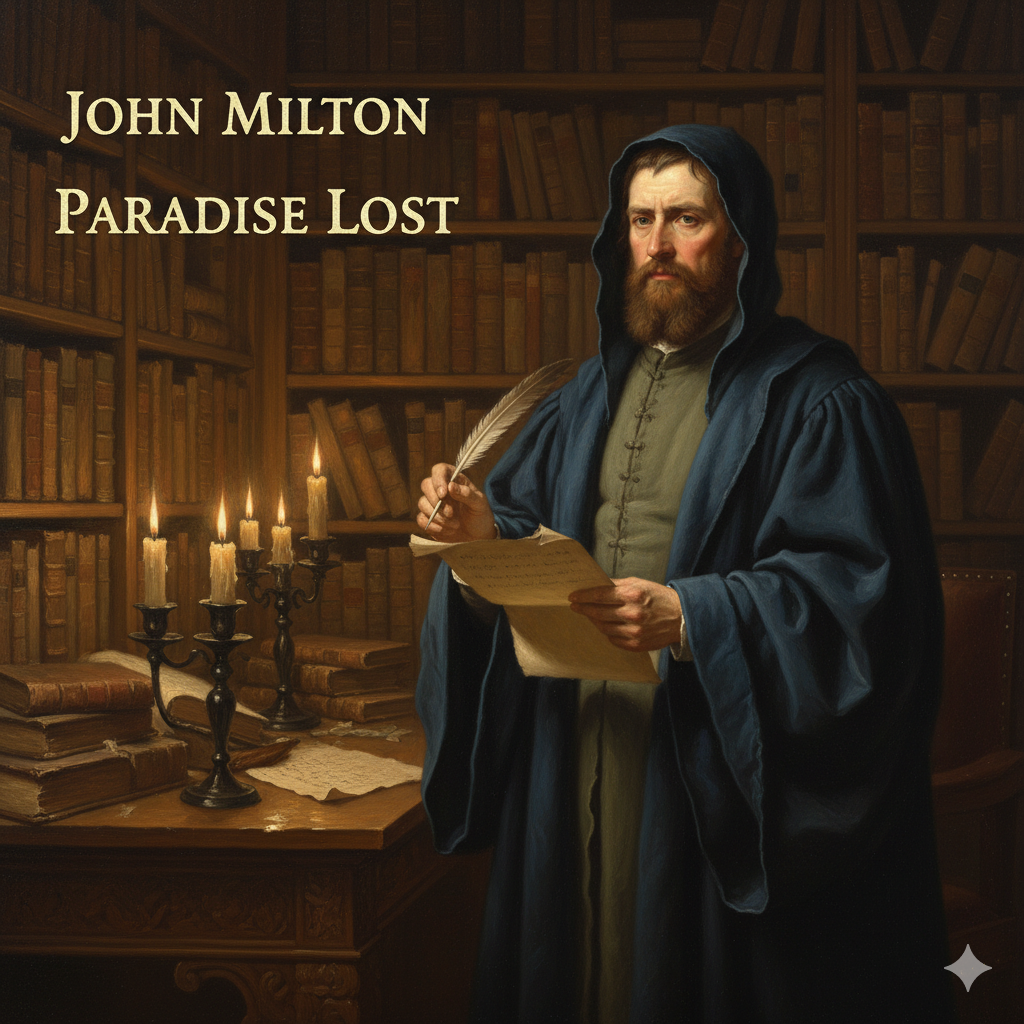
Early Life and Education:
John Milton was born on a December 9, 1608, in Bread Street, London. His Father John Milton Sr., was a scrivener (a professional legal clerk and moneylender) and also loved music.
His mother, Sara Jeffrey, was a deeply religious woman. From an early age, Milton showed extraordinary intelligence. He was educated at St. Paul’s School in London, where he studied Latin , Greek , and classical literature.
Later he went to Christ College Cambridge, where he earned his bachelor’s degree in 1629 and his master’s degree in 1632. Even in his youth, he dreamed of becoming a great poet and believed that poetry was a divine calling.
Journey as a Poet: ( The Most Famous Poem Paradise Lost)
After completing his studies, Milton didn’t take a job immediately. Instead he spent almost six years in private study at his father’s house in Buckinghamshire.
During this period, he read extensively in philosophy, history, theology, and Literature. In early 1630s, Milton began writing poems that reflected his deep knowledge and artistic skill. Some of his famous early works include:
“On the Morning of Christ’s Nativity” (1629) – a beautiful hymn celebrating the birth of Christ.
“Allegro” and “II Penseroso”(1631) – companion poems contrasting the joys of a cheerful life with the pleasure of a thoughtful, serious life.
“Comus”(1634) – a mosque (dramatic performance) that combines music, poetry, and dance, celebrating virtue and purity.
“Lycidas” (1637) – an elegy written for a friend who drowned, considered one of the finest pastoral elegies in English literature.
Travels in Europe
In 1638, Milton went on a long journey through French and Italy, where he met many scholars, artists and thinkers. He visited Galileo , the famous scientist, in Florence. This journey gave him broader knowledge of European culture and strengthened his vision as a poet.
Milton as a politics
When Milton return to England in 1639, the country was moving toward civil war between King Charles I and Parliament. Milton supported Parliament and became deeply involved in political and religious debates.
He wrote many powerful pamphlets (short political writings), defending freedom of speech, liberty and republican government. His most famous prose work is “Aeropathic” (1644), in which he argued strongly against censorship and supported the freedom of the press.
However, essay is still remembered as one of the greatest defenses of free expression in history. During the rule of Oliver Cromwell, Milton worked as Latin Secretary for foreign Affairs, where he wrote official documents for the government in Latin.
Personal Life and struggles
Milton’s personal life was filled with challenges. In 1642, he married Mary Powell, but the marriage was unhappy, and she left him for some time.
They were later reconciled, and Mary gave birth to four children before her death in 1652. Milton later married twice more. Tragedy stuck when Milton gradually lost his eyesight. By 1652, he was completely blind.
Yet, even in blindness, he continued to write and create some of his greatest works, dictating them to his daughters and assistants.
Major Works (PARADISE LOST)
- Paradise Lost (1667) – Paradise Lost is the greatest epic poem. His masterpiece, written after became blind. It is an epic poem in blank verse that tells the story of Satan’s rebellion against God, the fall of Adam and Eve, and the loss of paradise. It explores themes of free will, sin , redemption, and divine justice.
- Paradise Regained (1671) – A shorter epic poem that tells the story of Christ’s victory over Satan during his temptation in his wilderness.
- Samson Agonistes (1671) – A tragic poem written in the style of a Greek drama, based on the biblical story of Samson.
Later Years and Death
After the monarchy was restored in 1660, Milton’s political writings against kingship mad him a target. He was briefly imprisoned but later released. He spent his final years quietly, continuing to write and revise his works.
John Milton died on November 8, 1674, in London. He was buried in the church of St. Giles, Crip legate.
Legacy
Milton’s legacy is enormous. He is remembered not only as one of the greatest poets in English language but also as a fearless defender of freedom and truth.
His poetry combines deep religious faith, classical learning, and personal experience. Paradise Lost remains a masterpiece that continues to inspire readers worldwide.
Milton showed that even the suffering, blindness, and political defeat, the human sprit can rise to greatness through the power of imagination and faith.
Conclusion
John Milton lived a life of learning, struggle, and achievement. He believed that poetry was a way of serving both God and Humanity. His writings – both poetry and prose – continue to influence literature, politics, and thought even today.
Thought even today. Through his words, Milton taught the world that truth and freedom are worth fighting for, and that even in the darkest times, creativity and faith can shine like light.
Pingback: Geoffrey Chaucer – Father of English Poetry British Poet
Pingback: The use of nature in Romantic Poetry: Emotion, Spirit & Imagination
Pingback: Lord Byron: The Passionate voice of the romantic era
Pingback: “William Shakespeare: The Genius Who Reshaped World Literature Forever”
Pingback: The Evolution of Storytelling: From Oral Tradition to Digital Narratives englitcorner.com
Pingback: A Valediction: Forbidding Mourning – John Donne Metaphysical Vision Of Love englitcorner.com
Pingback: Study of William Shakespeare Sonnet 116-Let me not to the Marriage of True Minds englitcorner.com
Pingback: On His Blindness by John Milton Easy Summary englitcorner.com
Pingback: An Essay on Criticism by Alexander Pope englitcorner.com
Pingback: Shakespeare Sonnet 116 - A deep and Powerful Analysis